


* Australia: Admission is free at the Brisbane Botanic Gardens, where the Bonsai House displays hundreds of trees, some 80 years old.
* Belgium: The Belgian Bonsai Museum hosted by the Bonsai Centre Gingko at Laarne organizes international competitions and workshops.
* Canada: The Montreal Botanical Garden has an amazing indoor bonsai facility that can be viewed year round.
* China: View the bonsai at the Botanical Gardens in Beijing, Shanghai and Suzhou.
* Germany: The Grugapark in Essen has a permanent bonsai exhibition.
* Indonesia: Pluit Bonsai Centre in Jakarta is an enormous sales and trading centre for growers and collectors.
* Italy: The firm Crespi Bonsai hosts an international competition, the Crespi Cup, every year at the Bonsai Museum in Milan.
* Japan: Near Tokyo, the city of Omiya has an artisanal village of bonsai growers and stylists grow and maintain their stock. In Omiya Bonsai Village, more than a half dozen large bonsai nurseries allow visitors to view trees most days during growing season. By one estimate, more than 10,000 trees of world-class quality can be seen in a single day.
* Singapore: Thousands on bonsai are on display at the Chinese and Japanese Gardens on two islands in Jurong Lake.
* South Korea: The world's largest bonsai garden, Bunjae Artpia, is a major tourist attraction on Cheju Island; nearly 2,000 trees are on display.
* Spain: Visitors to Marbella can enjoy the collection at the Museo de Bonsai.
* United Kingdom: The Birmingham Botanical Gardens and Glasshouses hosts a rotating collection of about 25 trees at a time, and occasionally gives bonsai care workshops.
* United States: The National Arboretum in Washington, DC has an impressive collection of trees, some of them gifts from the Nation of Japan. The Arnold Arboretum in Boston, Massachusetts is home to the Larz Anderson Bonsai Collection. On the West Coast: the Weyerhaeuser Corporation maintains a collection open to the public at its headquarters near Seattle, and in Southern California the Huntington Library and Gardens in San Marino has a fine collection.

In Western culture, the word "bonsai" is used as an umbrella term for Japanese bonsai, Chinese penjing, and Korean bunjae.

| Bonsai Species | |
| Botanical Name | Common Name |
|---|---|
| Abies | Fir |
| Abutilon | Abutilon |
| Acer buergerianum | Trident Maple |
| Acer campestre | Field Maple |
| Acer circinatum | Vine Maple |
| Acer ginnala | Amur Maple |
| Acer monspessulanum | Montpelier Maple |
| Acer palmatum | Japanese Maple |
| Acer rubrum | Red Maple |
| Adenium obesum | Desert rose |
| Arbutus | Strawberry tree |
| Berberis | Barberry |
| Betula | Birch |
| Betula nigra | River Birch |
| Bougainvillea | Bougainvillea |
| Buxus | Box |
| Camellia | Camellia |
| Carmona microphylla | Fukien tea |
| Carpinus | Hornbeam |
| Cedrus | Cedar |
| Cedrus libani | Lebanon Cedar |
| Celtis sinensis | Chinese Hackberry |
| Chaenomeles | Flowering Quince |
| Chamaecyparis | Cypress |
| Chamaecyparis obtusa | Hinoki Cypress |
| Chamaecyparis pisifera | Sawara Cypress |
| Cornus | Dogwood |
| Cotinus coggygria | Smoke Tree |
| Cotoneaster | Cotoneaster |
| Crassula | Jades |
| Crataegus | Hawthorn |
| Cryptomeria | Sugi |
| Cydonia oblonga | Common Quince |
| Dasiphora fruticosa | Shrubby Cinquefoil |
| Ehretia microphylla | Fukien tea |
| Elaeagnus | Elaeagnus |
| Enkianthus | Enkianthus |
| Eugenia | Brush cherries |
| Euonymus | Spindle |
| Fagus | Beech |
| Ficus | Fig |
| Gardenia | Gardenia |
| Ginkgo biloba | Ginkgo |
| Gledista triacanthos | Honey Locust |
| Hibiscus syriacus | Hibiscus |
| Ilex | Holly |
| Jasminum nudiflorum | Winter Jasmine |
| Juniperus procumbens | Dwarf Japanese Garden Juniper |
| Juniperus chinensis | Chinese Juniper, Shimpaku |
| Juniperus squamata | Blue Juniper |
| Juniperus virginiana | Eastern Juniper |
| Lagerstroemia | Crape myrtle |
| Larix | Larch |
| Ligustrum | Privet |
| Liquidambar | Sweetgum |
| Lonicera | Shrubby Honeysuckles |
| Magnolia stellata | Star Magnolia |
| Malpighia | |
| Malus | Apple/Crabapple |
| Metasequoia | Dawn Redwood |
| Murraya paniculata | Orange Jasmine, Satinwood |
| Myrciaria cauliflora | Jaboticaba |
| Nandina domestica | Sacred or Heavenly Bamboo |
| Nashia inaguensis | Bahama berry |
| Neea buxifolia | |
| Olea | Olive |
| Olea europea | European Olive |
| Parthenocissus | Boston Ivy |
| Phyllostachys | Bamboo |
| Picea | Spruce |
| Pieris | Andromeda |
| Pinus clausa | Sand Pine |
| Pinus mugo | Mugo Pine |
| Pinus parviflora | Japanese White Pine |
| Pinus strobus | Eastern White Pine |
| Pinus thunbergii | Japanese Black Pine |
| Pinus virginiana | Virginia Pine |
| Pittosporum | Pittosporum |
| Podocarpus | Podocarpus |
| Portulacaria afra | Dwarf jade |
| Prunus serrulata | Japanese Flowering Cherry (櫻) |
| Prunus mume | Flowering Apricot (梅) |
| Pseudosasa | Bamboo |
| Punica granatum | Pomegranate |
| Pyracantha | Firethorn |
| Quercus | Oak |
| Rhaphiolepis indica | Indian Hawthorn |
| Rhododendron indicum | Satsuki azalea |
| Rhododendron obtusum amoenum | Kurume azalea |
| Robinia pseudoacacia | Black Locust |
| Sageretia theezan | Chinese sweet plum |
| Sasa | Bamboo |
| Serissa foetida | Serissa |
| Sorbus | Rowan and Whitebeam |
| Syzygium | Brush cherry |
| Tamarix | Tamarisk |
| Taxodium ascendens | Pondcypress |
| Taxodium distichum | Baldcypress |
| Taxus | Yew |
| Thymus | Thyme |
| Tsuga | Hemlock |
| Ulmus alata | Winged Elm |
| Ulmus crassifolia | Cedar Elm |
| Ulmus parvifolia | Chinese Elm |
| Wisteria floribunda | Japanese Wisteria |
| Wisteria sinensis | Chinese Wisteria |
| Zelkova serrata | Keaki |
Watering
Because of limited space in the confines of a bonsai pot, bonsai care can be quite difficult. The shallow containers limit the expanse of the root system and make proper watering practically an art in itself. While some species can handle periods of relative dryness, others require near-constant moisture. Watering too frequently, or allowing the soil to remain soggy can promote fungal infections and "root rot". Sun, heat and wind exposure can quickly dry a bonsai tree to the point of drought, so the soil moisture should be monitored daily and water given copiously when needed. The soil should not be allowed to become "bone dry" even for brief periods. The foliage of some plants cultivated for bonsai, including the common Juniper do not display signs of drying and damage until long after the damage is done, and may even appear green and healthy despite having an entirely dead root system.
In cooler climates, soil must not be allowed to become waterlogged as this may lead to root rot. In warmer climates, bonsai should be sat in a shallow watertight tray when not in use, and allowed to absorb water through the bottom of the pot throughout the day to prevent dehydration.
Repotting
Bonsai are generally repotted and root-pruned around spring time just before they break dormancy. Bonsai are generally repotted every two years while in development, and less often as they become more mature. This prevents them from becoming pot-bound and encourages the growth of new feeder roots, allowing the tree to absorb moisture more efficiently.
Wiring
Bonsai wiring is one of the most powerful tools to control the shape of the tree. The best time to wire a tree is in spring or fall when there is not as much foliage and the tree will not be too stiff. (Trees become stiff in winter while dormant because the sap pressure of the trunk and branches is much lower.)
To wire the tree wrap the trunk, and then each branch in spirals of bonsai wire so that the branch may be bent. The tree will then train the branch to grow in the desired direction. Another method of wiring involves attaching weights to the branches, causing them to sag and creating the impression of age.
Generally, wire is left on for one growing season. The tree should not be allowed to outgrow the wire, since this could cause the bark to become bound to the wire, making removal traumatic. When the time comes to remove the wire, it should be cut away in small pieces (rather than winding it off) as this will cause less damage to the foliage.
The thickness of the wire used should match the size of the branch— larger branches will require lower gauge wire. Two pieces of thinner wire paired together can be used in lieu of heavier wire. It is bad form to let any wires cross; this is most readily accomplished by starting from the base of trunk and working up.
When bending the branches, one should listen and feel for any sign of splitting. When bending a branch near the trunk extra caution should be used, as the branch is generally most brittle near the trunk. It is possible to gradually bend a branch little by little over the course of several months.
When working with the branches, consideration should be given to the style desired.
Tools
Special tools are available for the maintenance of bonsai. The most common tool is the concave cutter, a tool designed to prune flush, without leaving a stub. Other tools include branch bending jacks, wire pliers and shears of different proportions for performing detail and rough shaping. Aluminum or anodized copper wire is used to shape branches and hold them until they take a set.
Fertilization and soil
Opinions about soil mixes and fertilization vary widely among practitioners. Some promote the use of organic fertilizers to augment an essentially inorganic soil mix, while others will use chemical fertilizers freely. Bonsai soils are constructed to optimize drainage. Bonsai soil is primarily a loose, fast-draining mix of components, often a base mixture of coarse sand or gravel, fired clay pellets or expanded shale combined with an organic component such as peat or bark. In Japan, volcanic soils based on clay (akadama, or "red ball" soil, and kanuma, a type of yellow pumice) are preferred.
Containers
Every bonsai pot is equipped with drainage holes to enable the excess water to drain out. Each hole is typically covered with a plastic screen or mesh to prevent soil from escaping. Containers come in a variety of shapes. The ones with straight sides and sharp corners are generally better suited to formally presented plants, while oval or round containers might be used for plants with informal shapes. Quality bonsai containers are ceramic, and are high-fired so that they can withstand exposure to freezing temperatures. The most common containers are unglazed and brown in color. Glazed containers are also used, typically for deciduous and flowering trees. Economical containers of molded plastic or "mica" are available for developing bonsai, but most any container that provides good drainage can be used for developing bonsai material. Some enthusiasts construct their own "growing boxes" from scraps of fenceboard or wood slats.
Location
Contrary to popular bonsai are not suited for indoor culture, and if kept indoors will most likely die. While certain tropical plants (Ficus, Schefflera, etc.) may flourish indoors, most bonsai are developed from species of shrubs or trees that are adapted to temperate climates (conifers, maples, larch, etc) and require a period of dormancy. Most trees require several hours of direct or slightly filtered sun every day.
Overwintering
Some trees require protection from the elements in winter and the techniques used will depend on how well the tree is adapted to the climate. During overwintering, temperate species are allowed to enter dormancy but care must be taken with deciduous plants to prevent them from breaking dormancy too early. In-ground cold frames, unheated garages, porches, and the like are commonly used, or by mulching the plant in its container up to the depth of the first branch or burying them with the root system below the frost line.
Mallsai
Inexpensive bonsai trees often sold in chain stores and gift shops are derisively referred to as "mallsai" by experienced bonsai growers, and are usually weak or dead trees by the time they are sold. Often these bonsai are mass produced and are rooted in thick clay from a field in China. This clay is very detrimental to the bonsai, as it literally suffocates the roots and promotes root-rot. Very little if any shaping is done on mallsai, and often the foliage is crudely pruned with little finesse to resemble a tree. Due to the conditions under which they are transported and sold, they are often inadequately watered and are kept in poor soil, usually a clump of sphagnum moss or the aforementioned clay with a layer of gravel glued to the top, which leaves them susceptible to both drying and fungal infections. Some "mallsai" can be resuscitated with proper care and immediate repotting, although this is reportedly rare. This top layer of glued-on gravel should be immediately removed once the bonsai is purchased, and the plant should be repotted in a good bonsai soil such as akadama.
Collecting
Bonsai may be developed from material obtained at the local garden center, or from suitable materials collected from the wild or urban landscape. Some regions have plant material that is known for its suitability in form - for example the California Juniper and Sierra Juniper found in the American West, and Bald Cypress found in the swamps of Louisiana and Florida.
Collected trees are highly prized and often exhibit the characteristics of age when they are first harvested from nature. Great care must be taken when collecting, as it is very easy to damage the tree's root system (often irreparably) by digging it up. Potential material must be analyzed carefully to determine whether it can be removed safely. Trees with a shallow or partially exposed root system are ideal candidates for extraction. There is a legal aspect to removing trees, so the enthusiast should take all steps necessary to ensure permission from the owner of the land before attempting to harvest. If not, consider the right of the plant to stay where it is.
Shaping and dwarfing are accomplished through a few basic but precise techniques. The small size of the tree and the dwarfing of foliage are maintained through a consistent regimen of pruning of both the leaves and the roots. Various methods must be employed, as each species of tree exhibits different budding behavior. Additionally, some pruning must be done seasonally, as most trees require a dormancy period and do not grow roots or leaves at that time; improper pruning can weaken or kill the tree.
Most species suitable for bonsai can be shaped by wiring. Copper or aluminium wire is wrapped around branches and trunks, holding the branch in place until it eventually lignifies and maintains the desired shape (at which point the wire should be removed). Some species do not lignify strongly, or are already too stiff/brittle to be shaped and are not conducive to wiring, in which case shaping must be accomplished primarily through pruning.
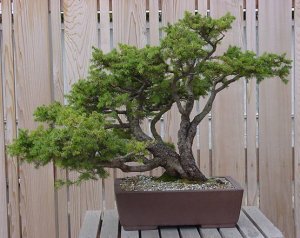
 A Pine bonsai in the informal upright style.
This tree is more than 30 years old in
the Hidden Lake Gardens Collection
- The formal upright is just as the name suggests, and is characterized by a tapering trunk and balanced branches. The informal upright is much like the formal, but may bend and curve slightly, although for aesthetic quality the tree should never lean away from the viewer.
- Cascade and semi-cascade are modeled after trees that grow over water or on the sides of mountains. Semi-cascades lean just over the rim of the pot where as cascades fall below the base of the pot.
- Raft style bonsai are bonsai which mimic a natural phenomenon where a tree that has been toppled (typically due to erosion or another natural force) begins to grow a new root system out of the part of the trunk that is in contact with the ground. Raft bonsai are typically planted with the original root system still intact and in contact with the soil. The bark on the underside of the trunk is trimmed off until the smooth wood underneath is visible; this wood is then placed in contact with the soil and, typically, the trunk is buried either immediately or over time. This group of bonsai can include many other styles such as sinuous, straight-line, and group planting styles. These all give the illusion of a group of trees, but are actually the branches of a tree planted on its side.
 A bonsai trident maple growing
in the root over rock style.
- The literati style is the hardest to define, but is seen often. The word literati is used in place of the Japanese bunjin which is a translation of the Chinese word wenren meaning "scholars practiced in the arts". The literati style is usually characterized by a small number of branches typically placed higher up on a long, contorted trunk. Literati bonsai often have the base of the crown beginning at a height lower than an S-shaped trunk bend, and the primary branch growing from below the S-bend, leading down and outwards with graceful sweeping lines. Their style is inspired by the Chinese paintings of pine trees that grew in harsh climates, struggling to reach the light of the sun.
- A group or forest bonsai display is, as the name suggests, a number of bonsai (typically an odd number if there are three or more trees) placed together in a pot. Typically the number of trees in a forest style display is fifty or less, though there is no formal limit. The trees are often the same species and are styled accordingly; although group or forest bonsai tend to contain smaller trees (which would be classified as mame style bonsai if they were planted alone), larger trees may be used.
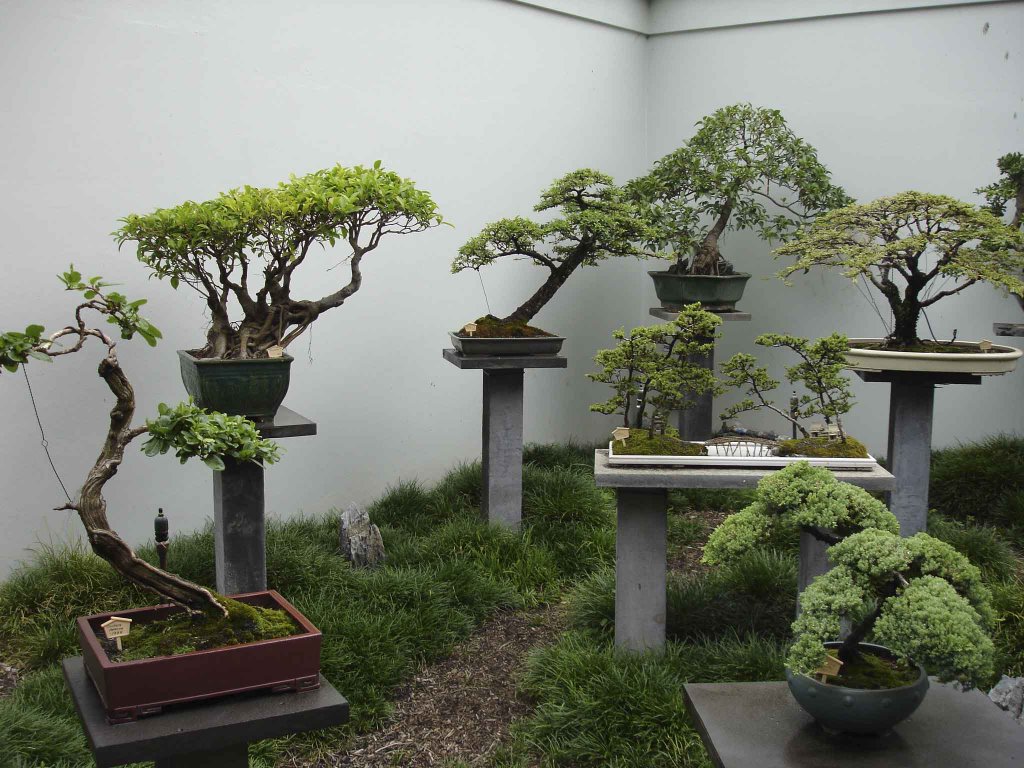
variety of different styles
Additionally, bonsai are classed by size. There are a number of specific techniques and styles associated with mame and shito sizes, the smallest bonsai. These are often small enough to be grown in thimble-sized pots, and due to their minuscule size require special care and adhere to different design conventions.
Japanese bonsai is derived from the Chinese artform, and was introduced to Japan by imperial embassies in the Chinese Tang Dynasty (the C7th–9th). In the Kamakura period, penjing that recalled customs from the Heian period came to be drawn in some picture scrolls and documents. In the Muromachi period, penjing developed into various directions in Japan. Just like a Japanese garden, it came to assume the artistry of "Wabi-sabi". However, the bonsai was still the enjoyment of people of the chosen hierarchy in the period. In the Edo period, it became possible for many daimyos, samurais, merchants, townsmen, and others to enjoy the art of bonsai. In addition, the bonsai pot became popular among daimyos, employing the pottery master who belonged exclusively to the bonsai pot. It is said that the name "Bonsai" started being used around this time. Indeed, a lot of bonsai were drawn in many an "Ukiyo-e (浮世絵)".
|Oriental Bonsai| |Jorge Novais Marketing| |Amazing Earth| |Power Beat| |Amazing Sports Cars| |Misterious Cat|